
Invoice fraud is when a scammer sends an email with “new bank details” that appears to come from a real supplier, so your next payment goes to the scammer instead. It is also called business email compromise (BEC) or payment redirection fraud, and the hardest part to accept is that the email is often genuine: it comes from the supplier’s own mailbox, which attackers took over weeks earlier.
The good news is that three simple payment habits stop it, even when the email itself looks perfect. Watch the full breakdown, or read the written guide below.
What invoice fraud looks like
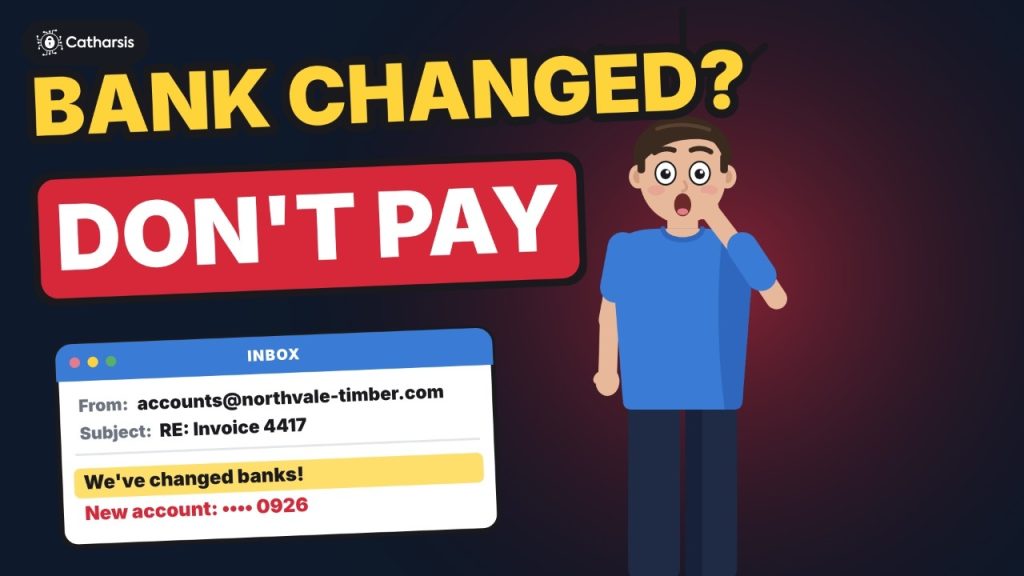
It usually starts with an ordinary message in an ordinary thread. A supplier you pay every month writes to say they have changed banks, and asks you to use the new account for the next invoice. The logo is right, the signature is right, the invoice number matches. Sometimes the message is “urgent”: the payment has to go out before 5pm, and it needs to stay quiet.
A common variant swaps the supplier for someone senior inside your own business, asking finance to rush a payment while they are “in a meeting”. The details change, but the pattern is the same: new payment details, time pressure and a request to skip the usual checks.
How big the problem is
Invoice fraud is not a niche scam. In its 2025 Internet Crime Report, the FBI’s Internet Crime Complaint Center (IC3) recorded 24,768 business email compromise complaints with losses of about $3.05 billion, making it the second-costliest type of cybercrime reported to the IC3 that year. A 2024 IC3 public service announcement put the total exposed to BEC between 2013 and 2023 at $55.5 billion.
Large organisations are not immune. Between 2013 and 2015, a fraudster used fake invoices to take more than $120 million from Facebook and Google; he pleaded guilty and was sentenced to five years in prison. In 2019, a European subsidiary of Toyota Boshoku lost more than $37 million to a BEC scam.
How the scammers get inside the email thread
There are two main routes, and it helps to know both.
- The real mailbox is hacked. The attacker phishes a password for someone at the supplier (or at your business), signs in, and reads the mail quietly. They learn who pays whom, when invoices are due and how people write. Then they reply inside a real thread at the right moment. Nothing about the sender address is fake, because it is the real account.
- A look-alike domain. The attacker registers an address that is one character off, such as northva1e instead of northvale, and copies the supplier’s style. On a phone, where you often only see the display name, the difference is easy to miss.
In the hacked-mailbox case, attackers often add a hidden mailbox rule that moves or deletes replies, so the real owner never sees the conversation about the “new” bank account. Security teams track this technique as MITRE ATT&CK T1564.008, Email Hiding Rules. It is one reason these scams can run for weeks without anyone noticing.
Who is at risk
Any organisation that pays suppliers by bank transfer is a target, but small and mid-sized businesses are especially exposed, because the same person often receives invoices, updates payee details and releases the payment. If one person can do all three on the same day, a single convincing email is enough.
What to do now: three habits that stop it
Because the email can be genuine, “spot the fake” is not a reliable defence. A process that checks every change of bank details is.
- The call-back rule. Verify any new or changed bank details by phoning a number you already have: from your supplier file, their website or a past invoice. Never use a number from the email asking for the change.
- Two people and a pause. One person updates the payee, a second person approves it, and the first payment to new details waits one business day. That pause gives time for the real supplier to notice and for checks to happen.
- Lock down the mailboxes. Turn on multi-factor authentication (MFA) for every email account; passkeys or security keys are strongest. Set up alerts for new mailbox rules and forwarding in Microsoft 365 or Google Workspace, and review them when they fire.
Two smaller habits help too: check the real sender address, not just the display name, especially on a phone; and treat urgency and secrecy (“pay before 5pm, keep it quiet”) as a reason to slow down.
Already paid? Do this first
Speed matters more than anything else.
- Call your bank immediately and ask for a recall of the payment.
- Report it: ReportCyber in Australia, ic3.gov in the US, Action Fraud in the UK, or your national police or cyber reporting service elsewhere.
- Tell the supplier, so they can secure their mailbox and warn other customers.
- Reset passwords on any mailbox involved, and check it for unfamiliar rules or forwarding.
Fast reporting matters: in 2025 the FBI’s Recovery Asset Team froze $679 million in reported losses.
FAQ
What is the difference between invoice fraud and business email compromise?
Invoice fraud is one form of business email compromise. BEC covers any scam where an attacker uses a hacked or impersonated business email account to trick someone into sending money or data; fake “new bank details” invoices are the most common version.
How can I tell if a supplier’s bank details change is real?
You often cannot tell from the email, because it may come from the supplier’s real account. Call the supplier on a number you already hold, not one in the email, and confirm the change before any money moves.
Can a bank get the money back?
Sometimes, if you act quickly. Call your bank straight away and ask for a recall, then report it to your national cybercrime service. The longer the delay, the harder recovery becomes.
Watch the 60-second version
How Catharsis can help
Catharsis Cyber Security is an ISO 27001:2022-certified MSP/MSSP helping businesses stay secure. We lock down Microsoft 365 and Google Workspace mailboxes, catch hidden mailbox rules and forwarding, and help you set up payment checks that hold up under pressure. See our email protection service or book a free security health check.
Sources
- FBI IC3 2025 Internet Crime Report
- FBI IC3 PSA: Business Email Compromise, The $55 Billion Scam (Sep 2024)
- US DOJ (SDNY): sentencing in the $120M+ fake-invoice scheme
- Sophos: Man jailed for $122 million scam that fooled Google and Facebook
- BleepingComputer: Toyota Boshoku subsidiary BEC loss
- UK NCSC: Business email compromise, payment diversion fraud
- MITRE ATT&CK T1564.008: Email Hiding Rules